
For many couples, retirement represents the opportunity to enjoy everything they have spent decades working toward. More time together, travel, family, new experiences, and the freedom to decide how they want to spend their days.
But as retirement approaches, an important financial question begins to emerge: Will our money last as long as we need it to?
For couples, that question is more complicated than it might initially appear. Retirement income needs to support two people who may have different retirement dates, different Social Security benefits, different healthcare needs, and potentially very different lifespans.
It also needs to adapt as life changes. Spending may be higher during the early years of retirement, healthcare expenses may increase later, and one spouse may eventually need to manage the household finances alone.
Creating retirement income that lasts isn't simply about choosing a withdrawal rate or accumulating a certain amount of money. It involves coordinating your income sources, investments, taxes, healthcare planning, and spending decisions so that your financial plan can support both spouses throughout retirement.
Start by Understanding Your Retirement Income Gap
Before deciding how to generate retirement income, couples should understand how much income they actually need.
Begin with the lifestyle you want to maintain. Consider housing, everyday living expenses, travel, family support, healthcare, taxes, and other financial commitments. Then compare those expenses with the income you expect to receive from sources such as Social Security and pensions.
The difference is your retirement income gap: the amount that must be funded by investments, retirement accounts, or other financial resources.
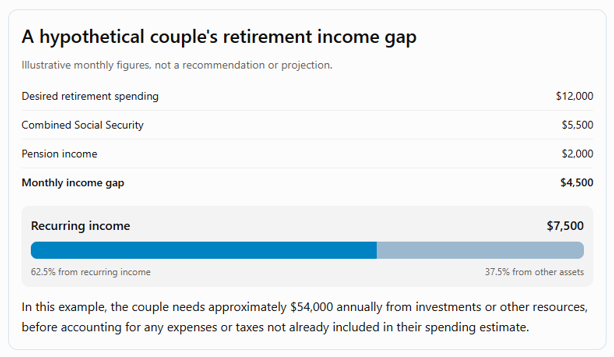
Once the income gap is clear, the planning conversation becomes more productive. Instead of asking whether you have accumulated enough money in general, you can begin evaluating how your available assets might support a specific income need.
That gap will likely change throughout retirement, which is why it should be revisited rather than treated as a permanent number.
Coordinate Social Security as a Couple
Social Security can be an important component of retirement income because eligible benefits generally continue for life and receive cost-of-living adjustments.
For married couples, however, claiming Social Security shouldn't necessarily be treated as two completely independent decisions.
Each spouse may have their own retirement benefit, and one spouse may also qualify for benefits based on the other's earnings record. Claiming ages affect monthly benefit amounts, and delaying an eligible retirement benefit beyond full retirement age can increase that benefit until age 70. SSA
There is also an important survivor consideration.
When one spouse dies, the surviving spouse generally does not continue receiving both full Social Security payments. Instead, the survivor may qualify for a benefit based on the deceased spouse's record, subject to eligibility and claiming rules. Delaying the higher earner's retirement benefit may increase the benefit ultimately available to the surviving spouse. SSA
For this reason, a couple's Social Security strategy should consider more than which claiming decision produces the most income during the first few years of retirement. It should also consider the potential income available to either spouse after the other dies.
Understand How Much You Can Reasonably Withdraw
Once Social Security and pension income have been considered, the remaining income gap often needs to be funded through withdrawals from investment and retirement accounts.
This introduces one of the central challenges of retirement income planning: determining how much you can withdraw while maintaining sufficient assets for an uncertain retirement horizon.
You may have heard of the 4% withdrawal rule. It is a commonly referenced starting point for retirement discussions, but it is not a guarantee that a portfolio will last. The sustainability of any withdrawal strategy depends on factors such as investment returns, inflation, taxes, asset allocation, withdrawal timing, spending flexibility, and the length of retirement.
For couples, the potential retirement horizon may extend well beyond the life expectancy of either spouse individually. The portfolio may need to support the household while both spouses are alive and then continue providing income to the survivor.
Rather than relying on a single withdrawal assumption, consider evaluating how the plan performs under different market conditions, spending levels, and retirement durations.
Recognize That the Timing of Investment Returns Matters
Two couples can earn similar average investment returns over retirement and still experience very different financial outcomes.
One reason is sequence-of-returns risk.
When a portfolio experiences significant losses early in retirement, withdrawals can require selling investments after their values have declined. Those withdrawals leave fewer assets available to participate in a potential recovery.
A couple experiencing strong investment returns early in retirement may have more flexibility than another couple that encounters several difficult market years immediately after leaving the workforce, even if their longer-term average returns eventually look similar.
This is why retirement income planning involves more than selecting investments with an attractive expected return.
Depending on individual circumstances, maintaining appropriate liquidity, diversifying investments, managing withdrawal amounts, and periodically adjusting spending may help a couple respond to unfavorable market conditions. Each approach involves tradeoffs and should be evaluated within the broader financial plan.
Consider the Role of Predictable Income
Some couples may want a portion of their essential retirement expenses supported by predictable sources of income rather than relying entirely on investment withdrawals.
Social Security and pensions can provide an important foundation. Depending on the couple's circumstances, certain annuities may also be considered as part of a retirement income strategy.
For example, an appropriately structured income annuity may provide contractual payments for a specified period or for life, subject to the issuing insurance company's claims-paying ability.
However, annuities differ considerably. Some involve limited liquidity, surrender charges, fees, restrictions, or reduced access to principal. Optional features and guarantees may involve additional costs, and inflation can reduce the purchasing power of fixed payments.
The relevant question isn't whether every couple should own an annuity. It's whether additional predictable income would address a specific need in the retirement plan and whether the benefits justify the associated costs and limitations.
For some couples, a combination of recurring income and diversified investments may provide a framework for supporting essential expenses while retaining assets for discretionary spending and future needs.
Plan for Two Lives—and the Possibility of One
This may be the most overlooked aspect of retirement income planning for couples.
A retirement plan can look sustainable while both spouses are alive but become more challenging after one spouse dies.
Household income may decline. A pension may be reduced or end, depending on the survivor benefit election. Social Security benefits may change, and the surviving spouse's tax situation may eventually be different.
Meanwhile, household expenses rarely decline by half. Housing, property taxes, insurance, utilities, and many other costs may remain relatively similar.
A comprehensive retirement income plan should therefore evaluate at least three scenarios: both spouses living throughout retirement, one spouse dying first, and the other spouse dying first.
This can reveal whether the surviving spouse would have sufficient income and accessible assets to maintain their lifestyle.
It can also help couples evaluate decisions involving Social Security, pension elections, life insurance, investment withdrawals, and estate planning before those decisions become difficult or impossible to change.
Incorporate Healthcare and Long-Term Care
Healthcare deserves its own place in the retirement income conversation.
A couple retiring before Medicare eligibility may need to budget for health insurance until each spouse becomes eligible. After Medicare begins, premiums, deductibles, prescription drugs, supplemental coverage, and other out-of-pocket expenses can continue to affect retirement spending.
Long-term care introduces a different financial risk.
Medicare and most traditional health insurance generally do not cover ongoing custodial long-term care, such as extended assistance with bathing, dressing, or other everyday activities. Medicare
For couples, a significant care event can create two simultaneous financial needs: paying for one spouse's care while maintaining the other spouse's lifestyle.
Planning may involve personal assets, long-term care insurance, family resources, or a combination of approaches. The appropriate strategy depends on health, age, assets, coverage availability, preferences, and the costs and limitations of available options.
The important point is to evaluate a potential care event before it becomes an unexpected source of substantial portfolio withdrawals.
Make Taxes Part of the Income Strategy
Not all retirement income is taxed in the same way.
Withdrawals from traditional retirement accounts are generally subject to ordinary income tax, while qualified Roth distributions may be tax-free. Taxable investment accounts can have different consequences depending on dividends, interest, capital gains, and cost basis.
For couples with assets across several account types, the order and timing of withdrawals can influence their tax situation.
Required minimum distributions, Roth conversions, charitable giving, and Medicare income-related premium adjustments may also become relevant at different stages of retirement.
A tax-aware retirement income strategy should consider both current and future taxes rather than focusing exclusively on minimizing taxes in any single year. Strategies such as Roth conversions can create immediate tax liabilities and are not appropriate for every household.
Coordination between financial and tax professionals can help couples evaluate these decisions in the context of their overall retirement plan.
Review Your Income Plan as Life Changes
A retirement income plan should not be something you create once and leave untouched for the next 30 years.
Markets change. Inflation affects purchasing power. Healthcare needs evolve. Spending priorities shift, and family circumstances may look very different at age 80 than they did at age 65.
Some couples may spend more during the early years of retirement when they are traveling and pursuing activities they previously had less time to enjoy. Spending may moderate later, although healthcare or long-term care needs could increase.
Periodic reviews provide an opportunity to compare actual spending with the original plan, reassess investment risk, update tax assumptions, and evaluate whether withdrawal amounts remain appropriate.
The objective isn't to eliminate uncertainty. It's to create a process for responding to it.
Questions Couples Should Ask Before Retirement
As you develop your retirement income plan, consider discussing the following questions together:
- How much income do we need to support our desired lifestyle, including taxes and healthcare?
- When should each of us claim Social Security, and how might those decisions affect the surviving spouse?
- What income will continue if one of us dies?
- How much of our spending will depend on investment withdrawals?
- How would a significant market decline early in retirement affect our plans?
- Would additional predictable income address a meaningful need?
- How would we fund a long-term care event without unnecessarily compromising the other spouse's financial security?
- Do both of us understand our accounts, income sources, and important financial decisions?
These conversations can also help identify areas where one spouse has historically handled most of the finances and the other may need additional information or involvement.
Frequently Asked Questions
How much money do couples need to retire comfortably?
There is no universal amount. The answer depends on desired spending, retirement age, recurring income, healthcare costs, taxes, investment assets, longevity, and other personal circumstances. Estimating the retirement income gap is a useful starting point.
Should married couples claim Social Security at the same time?
Not necessarily. Each spouse's age, earnings history, health, financial needs, and potential survivor benefits can influence the decision. Couples may benefit from evaluating their claiming options together rather than independently.
Can a couple rely entirely on investment withdrawals?
Some couples may have sufficient assets and risk tolerance to fund their income primarily through investments. Others may prefer additional predictable income. The appropriate approach depends on financial resources, spending needs, market risk, liquidity, and personal preferences.
What happens to retirement income when one spouse dies?
Social Security, pension income, taxes, and household expenses may all change. A retirement income plan should evaluate the financial circumstances of each potential surviving spouse rather than assuming the household's current income will continue unchanged.
Key Takeaway
Creating retirement income that lasts requires couples to plan for more than their expected spending during the first few years of retirement.
It means understanding their income gap, coordinating Social Security, establishing an appropriate withdrawal strategy, evaluating market and longevity risks, and preparing for healthcare expenses and the possibility that one spouse may eventually live alone.
The goal isn't to predict exactly how retirement will unfold. It is to create an income strategy that can adapt as circumstances change while continuing to support the lifestyle and priorities that matter to both spouses.
Final Thoughts
At Cypress Wealth Services, we believe retirement planning should begin with a conversation about the life you want to live, not simply the size of your investment portfolio.
For couples, that conversation should include the experiences you hope to share, the financial independence you want to maintain, and how you would want either spouse to be supported if life unfolds differently than expected.
A thoughtful retirement income plan connects your savings and investments with those priorities. It considers the income you can reasonably expect, the risks you may encounter, and the decisions that may need to change along the way.
Most importantly, it recognizes that retirement is a journey shared by two people who may have different needs at different times.
The objective is to create a financial plan that can support your life together while also preparing each of you for the years that may follow.
About the Author
Jim Bray, CFP®, is Managing Director and Senior Financial Advisor with Cypress Wealth Services. As a CERTIFIED FINANCIAL PLANNER™ professional, Jim works with individuals and families navigating retirement, wealth management, retirement income planning, and long-term care considerations. His approach emphasizes comprehensive planning and helping clients understand how decisions involving income, investments, healthcare, family, and longevity can work together throughout retirement.
Retire With Confidence and Clarity is an educational series focused on helping individuals and families navigate retirement planning decisions with greater understanding and purpose.
This article is provided for general educational purposes only and should not be construed as personalized investment, tax, legal, insurance, or financial advice.
All investments involve risk, including the potential loss of principal. Diversification and asset allocation do not ensure a profit or protect against loss. Retirement income projections, withdrawal strategies, and hypothetical examples are illustrative and do not guarantee future results. Annuity guarantees are subject to the issuing insurer's claims-paying ability, and annuity products may involve fees, surrender charges, liquidity restrictions, and other limitations. Individual circumstances vary. Consult appropriate financial, tax, legal, and insurance professionals before making decisions based on your specific situation.