
For many SpaceX employees, company stock may represent much more than an investment. It can reflect years of hard work, belief in the company's mission, and participation in its growth. As equity compensation accumulates and shares appreciate, it can also become one of the largest assets on your personal balance sheet.
That creates an important financial planning question: How do you know when you own too much of one company's stock?
There isn't a universal percentage that determines whether a position is too concentrated. The answer depends on your financial circumstances, other assets, career stage, taxes, and what you ultimately want your wealth to accomplish.
For some employees, company stock may represent a meaningful portion of their investments without threatening their immediate financial goals. For others, a similar position could create substantial risk, particularly if they are approaching retirement or relying on those shares to fund their family's future.
The starting point is understanding not just how much stock you own, but how much of your financial life depends on that stock continuing to perform well.
What Is Concentration Risk?
Concentration risk occurs when a substantial portion of your investments is exposed to a single company, industry, or other common source of risk.
Owning a significant position in one company can create substantial wealth when that investment performs well. However, it also means that an unfavorable development affecting that company could have an outsized impact on your portfolio.
For employees, the exposure may extend beyond their investment accounts. Your employer may provide your salary, benefits, bonuses, future equity compensation, and career opportunities. If you also hold substantial company stock, a difficult period for the business could potentially affect both your income and your investments.
FINRA specifically identifies employer stock as a potential source of concentration risk and encourages employees to consider their total holdings, including company shares held in retirement accounts. FINRA
This doesn't mean owning company stock is inherently inappropriate. It means the position deserves to be evaluated alongside everything else you own and everything you hope to accomplish.
Start by Calculating Your Actual Exposure
One of the simplest ways to begin is to calculate what percentage of your investable assets and overall net worth is represented by company stock.
Consider a hypothetical SpaceX employee with the following financial picture.
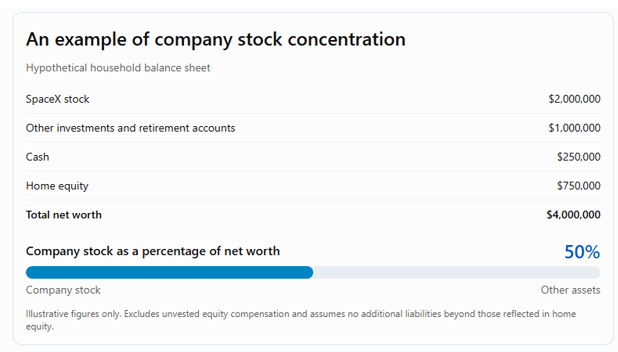
In this example, company stock represents 50% of net worth. But if we exclude home equity and focus on investable assets, the concentration is approximately 62%.
Both measurements provide useful information. The investable-asset calculation may be especially relevant when determining how much of the portfolio available to support retirement and other financial goals depends on one investment.
You should also examine unvested equity awards and future compensation separately. Although these may not be part of your current net worth, they can substantially increase your future exposure.
How Much Company Stock Is Too Much?
It's natural to want a specific number. Should company stock represent less than 10%, 20%, or 30% of your portfolio?
Different financial professionals may use different concentration thresholds as starting points for discussion, but a percentage alone cannot determine what is appropriate for your situation.
Someone with a long investment horizon, substantial diversified assets, and limited near-term spending needs may have a different capacity for concentration than someone whose retirement depends heavily on the value of a single stock.
The more useful question is whether the position creates risks that are inconsistent with your financial goals.
The SEC explains that appropriate asset allocation depends on an investor's time horizon and risk tolerance, while diversification can help reduce overall portfolio risk. Neither strategy eliminates the possibility of loss. Investor
Three Signs Your Company Stock Deserves a Closer Look
There are several circumstances that may indicate it is time to reassess your exposure.
- A Significant Decline Would Change Your Financial Plans
Imagine your company stock declined by 40%.
Would you still be able to retire when you planned? Could you still purchase the home you wanted, fund your children's education, or support your desired lifestyle?
If a substantial decline in one investment would force major changes to your plans, the position may be carrying more financial responsibility than you realized.
The objective isn't to predict whether a decline will happen. It's to understand whether your financial plan could accommodate one.
- Your Career and Your Investments Depend on the Same Company
SpaceX employees may have considerable exposure to the company even before considering their existing stock holdings.
Your current income, future equity awards, and career opportunities may all be connected to the same business.
When your investments are also heavily concentrated in that company, your financial risks can become interconnected. A company-specific setback could potentially affect multiple parts of your financial life at once.
- Your Wealth Has Grown, but Your Investment Strategy Hasn't Changed
Perhaps you accumulated company stock early in your career and continued receiving equity awards as the company grew.
Your financial circumstances may now look very different. You may have children, a larger home, different financial responsibilities, or the ability to retire earlier than originally expected.
An investment strategy that aligned with your circumstances ten years ago may no longer reflect your current priorities.
That doesn't necessarily require an immediate change to your holdings. It does suggest that your portfolio deserves a fresh evaluation.
Why Diversification Can Feel Difficult
Company stock is often different from other investments because employees have a personal connection to it.
You may understand the business, believe in its leadership, and feel optimistic about its future. You may also have accumulated substantial unrealized gains, making the potential tax consequences of selling difficult to ignore.
Diversifying can therefore feel like giving up future upside or expressing doubt about a company you believe in.
But diversification isn't necessarily a judgment about your employer's prospects. It is a decision about how much risk you want your family's financial future to depend on.
You can believe in SpaceX's long-term potential while also recognizing the value of owning assets whose performance is not tied to the same company.
Consider Taxes Before Making Changes
For employees with appreciated company stock, taxes can be a significant consideration.
Selling shares may create capital gains. Stock options, restricted stock, and other forms of equity compensation can also have different tax consequences depending on the type of award and the circumstances.
That makes it important to understand your cost basis, holding periods, potential tax liability, and any applicable trading restrictions before implementing a diversification strategy.
Depending on individual circumstances, potential approaches may include gradual sales over time, coordinating realized gains and losses, or incorporating appreciated shares into an existing charitable giving plan.
None of these strategies is appropriate for everyone, and some involve meaningful limitations or additional costs.
Equally important, employees must comply with applicable securities laws and company trading policies. Possessing material nonpublic information can restrict trading, and certain employees may have additional restrictions or preclearance requirements. Qualifying Rule 10b5-1 trading plans may be relevant in some circumstances but are subject to specific legal requirements. Investor
The goal is to evaluate investment risk, tax consequences, and trading requirements together rather than allowing any single consideration to drive the entire decision.
You May Be More Concentrated Than Your Portfolio Suggests
Diversification also requires looking beneath the surface of your other investments.
Suppose you own a substantial amount of SpaceX stock, along with several technology-focused funds and individual shares in other aerospace or technology companies.
Your account statements may show numerous different investments, but those holdings could still be exposed to similar economic conditions.
FINRA cautions that investments within the same industry or with similar underlying exposures may be highly correlated, even when they are held in different accounts or funds. FINRA
A comprehensive review should therefore consider not only how many investments you own, but also the risks they share.
Let Your Financial Goals Help Define the Appropriate Risk
One of the most important considerations is what your wealth is intended to accomplish.
If you are approaching retirement, the assets supporting your future income may warrant a different approach than investments intended for long-term growth.
If you plan to purchase a home in two years, you may want to evaluate whether money intended for that purchase should remain exposed to substantial stock-market fluctuations.
If you have already accumulated enough wealth to support your desired lifestyle, you may find that your priorities have shifted from maximizing potential growth toward maintaining financial flexibility.
A useful exercise is to model your financial plan under several hypothetical scenarios, including a significant decline in company stock, a period of limited liquidity, or a change in employment.
The purpose isn't to forecast the future. It is to understand which risks your plan can reasonably accommodate.
Frequently Asked Questions
What percentage of my portfolio should be in company stock?
There is no universally appropriate percentage. Your financial goals, investment horizon, other assets, future equity compensation, tax situation, and risk tolerance all influence how much concentration may be appropriate.
Should I sell my SpaceX stock to diversify?
That depends on your individual circumstances. Diversification may help reduce company-specific risk, but selling can create tax consequences and reduce your participation in potential future appreciation. Any strategy should also account for applicable trading restrictions.
Does owning other technology stocks make my portfolio diversified?
Not necessarily. Different companies within the same industry may respond similarly to economic or industry-specific developments. Diversification involves evaluating the underlying exposures of your investments, not simply the number of securities you own.
Should I count unvested stock when calculating my concentration?
Unvested equity generally should be evaluated separately from assets you currently own because vesting conditions, future valuations, and other restrictions may apply. However, expected future awards can be important when assessing your broader financial exposure.
Key Takeaway
The question isn't simply whether you own too much SpaceX stock. It's whether the amount you own is consistent with your financial goals and your ability to withstand a significant decline.
Understanding your concentration requires looking at your entire financial picture, including existing investments, future equity compensation, career exposure, taxes, and upcoming financial decisions.
A thoughtful approach allows you to evaluate how much company-specific risk you are willing and financially able to accept without making your long-term plans unnecessarily dependent on one outcome.
Final Thoughts
At Cypress Wealth Services, we believe financial planning should evolve as your circumstances change.
For SpaceX employees, years of equity compensation and company growth may have created financial opportunities that were difficult to imagine earlier in their careers. As that wealth grows, however, the decisions surrounding it can become increasingly important.
The same stock that helped create your wealth may continue to play a meaningful role in your portfolio. But it is worth periodically asking whether the position still fits the financial life you are building.
Understanding your concentration, evaluating the potential consequences, and coordinating your investment decisions with your broader financial plan can help you approach those choices with greater confidence and clarity.
About the Author
David Thatcher, CFP®, is a Partner and Senior Financial Advisor with Cypress Wealth Services. As a CERTIFIED FINANCIAL PLANNER™ professional, David provides comprehensive wealth planning to high-net-worth families, business owners, and successful professionals, including technology employees and executives. His approach emphasizes thoughtful planning, risk management, and helping clients coordinate investments, equity compensation, taxes, retirement, and multigenerational financial goals.
Financial Insights for SpaceX Employees and Executives is an educational series designed to help employees better understand the financial planning considerations associated with equity compensation and wealth creation.
SpaceX is not affiliated with or endorsed by Cypress Wealth Services. References to SpaceX are for educational purposes only.
Investment advisory services are offered through Cypress Wealth Services, an SEC-registered investment adviser. This article is provided for general educational purposes only and is not personalized investment, tax, or legal advice or a recommendation to buy, sell, or hold any security. Diversification and asset allocation do not guarantee a profit or protect against loss. Concentrated stock positions involve company-specific risks, while diversification may reduce exposure to future appreciation in a particular security and can involve taxes and transaction costs. Equity compensation, trading restrictions, and tax consequences vary by individual. Consult qualified financial, tax, and legal professionals regarding your circumstances.